
What Actually Happens During an Abortion? Part 2 (Part 2 of 5)
Suction Aspiration - Part 2
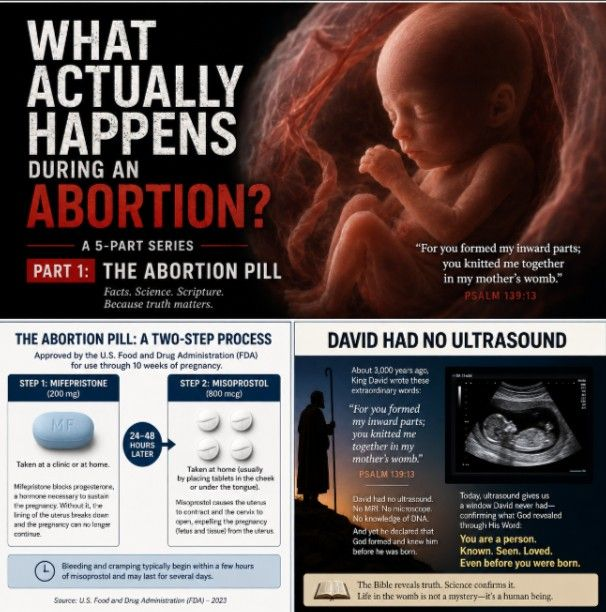
In Part 1, I explained what happens during a medication abortion, commonly called the abortion pill.
Now we move from pills to instruments.
This procedure has several clinical names: vacuum aspiration, suction aspiration, or suction curettage. Those terms sound sterile.
So let's describe exactly what they mean. The American College of Obstetricians and Gynecologists (ACOG), an organization that supports access to abortion, says vacuum aspiration is the procedure typically used for first-trimester procedural abortions and is usually offered through 13 weeks of pregnancy.
The World Health Organization (WHO) recommends vacuum aspiration for surgical abortion before 14 weeks.
This is not a description coming from a pro-life organization. It comes directly from major medical organizations that support abortion access.
Step One: Opening the Cervix
The procedure begins with access to the uterus.
According to ACOG, a speculum is placed into the vagina. The cervix is then usually dilated, meaning opened wider, using medication or dilators. This matters because the uterus is where the pregnancy is developing. The abortion provider needs an opening large enough to pass an instrument through the cervix and into the uterus.
Step Two: The Suction Tube
Once the cervix has been opened, a thin plastic tube called a cannula is passed through the cervix and into the uterus. That tube is connected to a source of suction. There are two principal forms. Manual vacuum aspiration (MVA) uses a handheld aspirator to create suction. Electric vacuum aspiration (EVA) uses an electric vacuum pump. Different equipment. Same basic objective.
Create suction inside the uterus and remove the pregnancy.
Step Three: The Pregnancy Is Suctioned Out
Here is where clinical terminology can make something very physical sound abstract.
ACOG states plainly that the tube is attached to a suction or vacuum pump “which removes the pregnancy.”
Think about what those words mean.
Before the procedure, a developing embryo or fetus, placenta, gestational sac and other pregnancy tissue are inside the uterus.
The suction device is not preventing conception.
It is not preventing implantation.
A pregnancy already exists.
The cannula is inserted into the uterus, suction is applied, and the pregnancy is removed.
That is a suction abortion. Yummy....said no one in their right mind.
What Happens to the Unborn Child?
This deserves careful wording because the answer depends upon gestational age. During the earliest weeks of pregnancy, the embryo is extremely small. As pregnancy progresses through the first trimester, the embryo and then fetus grows rapidly and becomes increasingly anatomically developed. Vacuum aspiration removes the developing pregnancy through the suction cannula.
The removed material can include embryonic or fetal tissue, placental tissue, the gestational sac, blood and other uterine contents. Medical literature often collectively refers to this material as “products of conception.” That is medically established terminology, but terminology should not prevent the reader from understanding what those words include.
When vacuum aspiration is being performed as an induced abortion, the material being removed includes the pregnancy that the procedure was performed to end.
Step Four: Making Sure the Uterus Is Empty
The procedure does not necessarily end the instant suction stops. ACOG states that an instrument called a curette can also be used to remove the pregnancy. The term dilation and curettage (D&C) refers to opening the cervix and removing tissue from inside the uterus with a curette, although ACOG notes that the term D&C is sometimes also used when suction is involved.
There is an important distinction here.
D&C and vacuum aspiration are also used for legitimate medical purposes following miscarriage and in other circumstances. The instrument itself is not what makes an abortion an abortion. The purpose of an induced abortion is to intentionally end the life of an unborn human being. That distinction matters.
The Removed Tissue Is Examined
The World Health Organization's abortion-care guideline describes assessing whether the abortion is complete through visual inspection of the products of conception. Put that into ordinary English. After the contents have been suctioned from the uterus, the removed material can be examined to determine whether the procedure successfully removed the pregnancy. Again, the medical terminology sounds distant.
But the procedure itself is physical. The pregnancy was inside the uterus. The cervix was opened. A tube was inserted. Suction was applied. The pregnancy was removed. And the removed material may then be examined to determine whether the abortion is complete.
Why Plain English Matters
I expect some people will object to the language in this series. They may prefer uterine evacuation. They may prefer products of conception. They may prefer pregnancy tissue. Those are legitimate medical terms, and I am not claiming otherwise. But ordinary Americans should also understand what those terms describe. ACOG itself says the suction device removes the pregnancy.
I believe that pregnancy contains an unborn human being whose life has value before God. So I refuse to discuss the procedure as though the human being developing inside the uterus somehow disappears when medical terminology is applied to it. The words may change. What physically happens does not.
Want to See This Procedure Depicted?
The 2019 film Unplanned dramatizes the story of Abby Johnson, a former Planned Parenthood clinic director who later became a prominent pro-life advocate. The film includes a disturbing reenactment of an ultrasound-guided abortion procedure that Johnson says became a turning point in her life.
This distinction matters: the scene is a dramatization, not documentary footage of an actual abortion. The film is based on Johnson's account of her experiences, and claims surrounding her story have been disputed. It should therefore be viewed as a dramatic depiction, not as independent medical proof of what happens during every suction abortion.
That is why this article does not rely on the movie to establish the medical facts. The descriptions above come from medical authorities such as the American College of Obstetricians and Gynecologists (ACOG) and the World Health Organization (WHO).
Still, for readers who want to see a dramatic visual depiction of the type of procedure discussed in this article, Unplanned is worth knowing about. Its official website describes the movie as the story of Johnson's transformation from Planned Parenthood clinic director to pro-life advocate. The film is rated R for disturbing and bloody images.
Sources
American College of Obstetricians and Gynecologists (ACOG): Abortion Care. ACOG describes first-trimester vacuum aspiration, cervical dilation, insertion of a plastic tube into the uterus and removal of the pregnancy using suction.
World Health Organization (WHO): Abortion Care Guideline, Second Edition. WHO recommends vacuum aspiration for surgical abortion before 14 weeks and discusses assessment of completeness through inspection of the products of conception.
World Health Organization (WHO): Clinical Practice Handbook for Quality Abortion Care. WHO provides clinical instructions for performing vacuum aspiration and describes manual and electric vacuum aspiration.
Merck Manual Professional Edition: Procedural and Medical Abortion. Merck describes dilation and suction curettage before 14 weeks, manual vacuum aspiration and electric vacuum aspiration.
Unplanned (2019): The film dramatizes Abby Johnson's account of her experiences inside Planned Parenthood and her later transformation into a pro-life advocate. The abortion scene referenced above is a reenactment and should not be confused with documentary footage.
Next: Part 3, Dilation and Evacuation (D&E). This is where the procedures become considerably more difficult to read about.
Latest Articles, Submissions & Community Highlights
Participating groups, neighborhood leaders, and citizen coalitions can share news, documents, or resources here.